


Our 2027 Live Stream Schedule Will be Announced Soon!
Links to Watch the Sinkhole Odyssey Stream & Previous Streams Below
What can Lake Huron tell us about early life on Earth? Join a livestreamed exploration of one of the Great Lakes’ most extraordinary underwater environments and discover a world that resembles the Earth as it was 2.5 billion years ago.
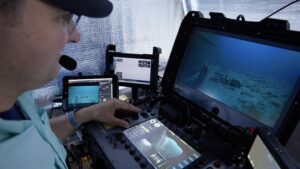
Melnick at ROV Controls
Hidden beneath the waters of Lake Huron lies the Middle Island Sinkhole. Formed over thousands of years as groundwater dissolved the limestone beneath the lakebed, the sinkhole plunges 80 feet below the surface into a colorful ecosystem unlike anything in the Great Lakes. This rare environment attracts researchers from around the world seeking clues about early life on Earth.
Freshwater explorers and filmmakers Zach Melnick and Yvonne Drebert are teaming up with Thunder Bay National Marine Sanctuary and Great Lakes Now for the first-ever livestream from this underwater time capsule, providing an up-close look at an area that, until now, has only been experienced by advanced divers. Using a high-tech remotely operated vehicle (ROV) equipped with high-resolution cameras, the team will descend into the sinkhole, following divers as they collect samples from the remarkable microbial mats that carpet the bottom.
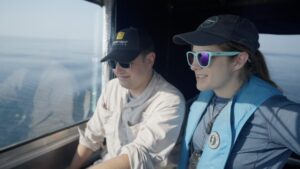
Drebert and Melnick Pilot Boat
Viewers will get an up-close look at the sinkhole’s colorful bacterial communities, vast carpets splotched with shades of purple, brown, and white. Scientists believe this globally significant ecosystem can provide insights into how life evolved on early Earth and how the planet’s first oxygen-producing organisms transformed the atmosphere. While beautiful to look at, the sinkhole is deadly to most other lake lifeforms due to the water’s lack of oxygen.
Along for the journey will be Dr. Bopaiah Biddanda from Grand Valley State University, an Aquatic Microbial Ecologist who has spent years studying the sinkhole’s unique ecosystem. Sarah Morrison, Media and Outreach Specialist at Thunder Bay National Marine Sanctuary, will share how the sanctuary supports researchers looking to uncover the secrets of the sinkhole.
Biddanda, Morrison, Melnick, and Drebert will answer audience questions in real-time during the dive.
NOTE: The date and time are subject to last-minute change due to weather conditions.

About Hidden Below LIVE
Hidden Below: The Great Lakes is a wildlife documentary that will premiere in 2028, but you don’t have to wait. With Hidden Below: LIVE, you can join the team through exciting livestream dives to some of the lake’s most amazing places. Each livestream combines cinema-grade underwater robotics with real-time commentary from expert guests. Explore alongside Yvonne and Zach and have your questions about the mysteries of the deep answered in real time. Hidden Below LIVE is brought to you by Great Lakes Now/ Detroit PBS, and all of the amazing Hidden Below partners! 
Previous Hidden Below LIVE Events
Weren’t able to tune in live? See below for recordings of all the Hidden Below LIVE expeditions.
Superior Maximus. June 07, 2026. We visited the deepest spot in the Great Lakes – LIVE. Working with the Michigan Department of Natural Resources, we plunged more than 400 meters (1300 feet) below the surface in Lake Superior. We saw high densities of deepwater sculpin, a strange freshwater creature called a hydra, potential deep water lake trout spawning habitat, and an old beer can – proving that humans have impacted even the deepest, darkest realms of the freshwater world.
Fish City. April 22, 2026. The Great Lakes are not an untouched wilderness, but an aquatic ecosystem intertwined with human activities. Among the largest intersections of humans and nature occurs at the Bruce Power Generating Station on Lake Huron, the largest nuclear power plant in North America. The plant warms the cold lake waters, attracting fish and modifying their habitat. We dive into these warmers waters to meet several species drawn to the plant, including many that are difficult to see elsewhere, like the bigmouth buffalo, the gizzard shad and freshwater drum, along with well-known species such as smallmouth bass and common carp.
The Freshwater Everest. On September 14th, 2025, the Zach and Yvonne did a livestream from the “Freshwater Everest” aka “Superior Shoal”, a submerged mountain range that also happens to be one of the most remote freshwater sites on Earth. They explored volcanic rock formations, underwater canyons, rare redfin lake trout – including some spawning activity, deepwater sculpin, and a mysterious piece of wood!



Our Partners In Freshwater Life Support